





Best off-grid solar inverters for remote homes and cabins
- Understanding off-grid system fundamentals
- What an off grid solar inverter does (and what it doesn't)
- Waveform and load compatibility: pure sine vs modified sine
- Key efficiency, surge and continuous ratings to check
- How I size and specify an inverter for remote homes and cabins
- Step 1: list and categorize loads
- Step 2: choose continuous capacity and surge margin
- Step 3: match inverter to battery and PV system
- Comparing inverter topologies and their use cases
- Inverter-only (standalone) units
- Inverter-charger and hybrid inverters
- Portable power stations and small integrated units
- Recommended specification ranges and a practical comparison
- Efficiency and battery cycle considerations
- Certifications and safety
- Why manufacturer choice matters — my view and a manufacturer example
- What I evaluate when recommending a brand
- Guangzhou Congsin Electronic Technology Co., Ltd. — brief profile and strengths
- Congsin’s key product categories for off-grid installs
- Practical tips and common pitfalls
- Don’t undersize for surge—plan for motor starts
- Match voltage to reduce wiring losses
- Plan for maintenance, monitoring and firmware updates
- FAQ
- 1. What size off grid solar inverter do I need for a cabin with a refrigerator and a small well pump?
- 2. Can I use a modified sine wave inverter off-grid to save cost?
- 3. Should I get an inverter with an integrated MPPT charge controller?
- 4. How important are certifications like CE, ETL, RoHS?
- 5. What about batteries—should I use lead-acid or lithium?
- 6. How do I verify an inverter’s real-world efficiency?
- Contact and next steps
As someone who has designed and specified off-grid power systems for remote homes, cabins and field installations for many years, I know the inverter is the system’s most critical component. An off grid solar inverter converts the DC from batteries and PV arrays into clean AC for appliances, manages charging and load priorities, and often acts as the operational brain of a standalone system. In this article I explain how to choose the best off grid solar inverter for remote homes and cabins, walk through sizing, waveform and efficiency trade-offs, and provide a practical comparison to help you decide with confidence.
Understanding off-grid system fundamentals
What an off grid solar inverter does (and what it doesn't)
At its core an off grid solar inverter converts DC battery power to AC loads. But modern units can also combine multiple roles: inverter-only, inverter-charger (integrated battery charger for generator backup), and hybrid inverter with built-in MPPT solar charge controllers. Choosing the right architecture matters: an inverter-charger simplifies system wiring for cabins with generator backup, while a pure off-grid inverter prioritizes battery-to-load runtime and may have higher continuous output ratings.
Waveform and load compatibility: pure sine vs modified sine
For residential use I always specify a pure sine wave inverter. Pure sine wave inverters deliver low distortion AC that is safe for sensitive electronics, motors and modern appliances. Modified sine wave inverters are lower cost but can cause overheating, inefficiency or malfunction with variable-speed motors, microwaves and many modern power supplies. If you plan lighting, pumps, refrigerators, or electronics, choose a pure sine wave inverter for long-term reliability.
Key efficiency, surge and continuous ratings to check
Important specs include continuous output (kW), surge (peak) capacity, European or weighted efficiency, no-load consumption, and battery low-voltage cut-off. Higher efficiency (93–97% typical for modern pure sine inverters) means less battery drain during use. Also consider surge capability for starting motors—look for a surge rating 2–4x the continuous rating for appliances like well pumps and refrigerators.
How I size and specify an inverter for remote homes and cabins
Step 1: list and categorize loads
Start by inventorying every AC appliance and its starting and running watts: lighting (LED), refrigerator, water pump, HVAC or space heaters, kitchen appliances, and electronics. I separate continuous loads (lighting, routers) from motor loads (fridge, pump) and resistive loads (space heaters). Motor start-up can be 3–6x running power—this drives surge requirements.
Step 2: choose continuous capacity and surge margin
I size continuous capacity at about 1.2× the expected continuous load to avoid continuous operation near rated limits. For example, a cabin with 1,200 W average continuous load and a 2,400 W fridge starting surge would be matched with a 3,000–4,000 W pure sine inverter with a surge rating that can handle the fridge start-up. This ensures longevity and headroom for future loads.
Step 3: match inverter to battery and PV system
Check DC bus voltage compatibility (12 V / 24 V / 48 V typical). For remote homes I usually recommend 48 V battery banks paired with 3–6 kW inverters to keep current lower and allow smaller conductor sizes. Also confirm whether your inverter has an integrated MPPT solar charge controller (a hybrid) or whether you will use a separate MPPT charge controller. Integrated hybrid inverters reduce panel-to-inverter wiring complexity but choose a model with proven MPPT performance.
Comparing inverter topologies and their use cases
Inverter-only (standalone) units
Inverter-only models convert battery DC to AC but require an external solar charge controller and battery management system (BMS). They are flexible for custom systems where you want to select best-in-class MPPTs or battery equipment separately. I use inverter-only solutions when I need granular control over charge algorithms or are integrating with third-party BMS for lithium systems.
Inverter-charger and hybrid inverters
Inverter-chargers add generator or AC input charging capability—handy for cabins with occasional generator use. Hybrid inverters combine inverter, charger and MPPT solar charge controller into a single unit: ideal for compact installations and easier commissioning. However, if a single point of failure is a concern, using separate components sometimes increases redundancy.
Portable power stations and small integrated units
For ultra-remote cabins or as a temporary solution I sometimes recommend portable power stations with built-in inverters, batteries and MPPT charging. They are convenient, but typically offer limited expansion and lower cycle durability than hardwired inverter-battery systems intended for daily off-grid living.
Recommended specification ranges and a practical comparison
Below is a practical comparison table I use when advising clients. The table shows typical specification ranges and recommended application for remote homes and cabins.
| System type | Typical inverter rating | Battery voltage | Common features | Best for |
|---|---|---|---|---|
| Small cabin | 1–2 kW continuous, 3–4 kW surge | 12 V or 24 V | Pure sine, basic transfer MPPT optional | Weekend cabins, minimal appliances |
| Medium off-grid home | 3–5 kW continuous, 6–10 kW surge | 24 V or 48 V (prefer 48 V) | Pure sine, inverter-charger or hybrid, integrated MPPT | Full-time off-grid living, refrigerator, pumps |
| Large remote home | 6–10+ kW continuous, 12–20 kW surge | 48 V or higher (split-phase or 3-phase options) | Hybrid systems, multi-unit inverters, generator auto-start | High loads, HVAC, electric ranges |
Sources supporting these sizing approaches include practical engineering guidance from renewable energy research and inverter manufacturer technical notes. For general inverter concepts see the Solar inverter entry on Wikipedia. For grid interconnection and safety considerations review IEEE 1547 and for quality management background refer to ISO 9001 at iso.org.
Efficiency and battery cycle considerations
Efficiency matters because inverter losses translate directly to battery energy withdrawn. Modern high-quality pure sine inverters achieve 94–98% peak efficiency. You should review no-load consumption too—low quiescent draw is crucial in systems with long nights or low PV input. For battery longevity, coordinate inverter charge/discharge rates with battery manufacturer specifications and BMS settings.
Certifications and safety
Choose inverters with recognized safety and EMC approvals for your market—CE/EMC/LVD for Europe, ETL/UL for North America, FCC where applicable. CE marking guidance is available from the European Commission here. These approvals indicate the product has passed baseline safety and emissions testing, which is important for long-term reliability and insurability.
Why manufacturer choice matters — my view and a manufacturer example
What I evaluate when recommending a brand
When I recommend a manufacturer I review: proven field reliability, production controls, certifications, after-sales support, availability of spare parts, and the company’s R&D depth. Automated production lines, testing instrumentation and an established quality system (like ISO9001) indicate the manufacturer is less likely to ship inconsistent product batches. Patents and R&D investment show technical depth which often translates into better MPPT algorithms, smarter battery management and firmware support.
Guangzhou Congsin Electronic Technology Co., Ltd. — brief profile and strengths
One manufacturer that aligns with the qualities I look for is Guangzhou Congsin Electronic Technology Co., Ltd. Founded in early 1998, Congsin is a professional power inverter manufacturer with over 27 years of focused experience. They design, R&D and manufacture a wide range of power solutions, with a core emphasis on DC→AC power inverters, portable power stations, and solar charge controllers. Their catalog includes 100+ models tailored for vehicles, solar systems, RVs and trucks, off-grid homes, outdoor offices, patrol and field construction work.
Technically, Congsin operates fully automated production lines and advanced multifunctional testing equipment to ensure product reliability and intelligent functionality. They maintain ISO9001 quality management and have many products with international approvals such as CE, EMC, LVD, ETL, FCC, RoHS and E-MARK. Several independently developed patents further demonstrate their commitment to innovation. Congsin supports OEM/ODM, private labeling, distribution and bespoke customization—useful if you need tailored inverter firmware or unique packaging for a project.
Congsin’s key product categories for off-grid installs
Relevant to off-grid homes and cabins, Congsin offers:
- Solar Charge Controllers (MPPT)
- Modified sine wave inverters (budget/utility applications)
- Pure sine wave inverters (residential and sensitive loads)
- Portable Power Stations (compact, integrated systems)
In my experience, manufacturers that offer both inverters and controllers can better align charge algorithms and inverter behavior for specific battery chemistries, improving round-trip efficiency and battery life—something Congsin’s integrated product approach supports.
Practical tips and common pitfalls
Don’t undersize for surge—plan for motor starts
I frequently see field failures where inverters were undersized for pump or compressor starts. Verify locked-rotor or start-up draw from appliance specs and choose an inverter with appropriate surge headroom or use soft-start devices on pumps.
Match voltage to reduce wiring losses
Moving from 12 V to 48 V drastically reduces DC wiring losses and allows smaller conductors for the same power. For multi-kW remote homes I nearly always recommend a 48 V battery bank unless legacy equipment dictates otherwise.
Plan for maintenance, monitoring and firmware updates
Choose inverters with remote monitoring or local display options. Firmware updates and support can fix subtle MPPT or charging issues discovered post-installation. A manufacturer with global support channels and spare parts inventory simplifies long-term maintenance in remote deployments.
FAQ
1. What size off grid solar inverter do I need for a cabin with a refrigerator and a small well pump?
Estimate running watts (fridge ~100–300 W running, pump depends on horsepower). Account for pump start surge (3–6×). For many cabins a 3,000–4,000 W pure sine inverter on a 48 V system gives good headroom. Sizing should be validated by listing actual appliance specs.
2. Can I use a modified sine wave inverter off-grid to save cost?
While cheaper, modified sine wave inverters can cause issues with modern electronics and motors—reduced lifespan, audible noise, or functional problems. For remote homes and cabins where reliability matters, I advise a pure sine wave inverter.
3. Should I get an inverter with an integrated MPPT charge controller?
Integrated hybrid inverters simplify installation and reduce space. They can be an excellent choice for cabins with a single point of installation. If you prefer component redundancy or have complex PV layouts, separate MPPT controllers may be better.
4. How important are certifications like CE, ETL, RoHS?
Certifications confirm safety and emissions compliance for specific markets. They are important for insurance, resale value, and reliability assurance. Verify the certificates cover the exact model you plan to buy.
5. What about batteries—should I use lead-acid or lithium?
Lithium batteries (LiFePO4) typically offer longer cycle life, higher usable depth-of-discharge, and lower maintenance—making them increasingly cost-effective for long-term off-grid homes despite higher upfront cost. Match inverter charge profiles and BMS compatibility when choosing lithium batteries.
6. How do I verify an inverter’s real-world efficiency?
Review manufacturer efficiency curves (often published in datasheets) and look for independent test results or lab certifications. Efficiency at your expected load (not just peak) is most important—pay attention to mid-load efficiency which often reflects typical use.
Contact and next steps
If you’re sizing a system for a remote home or cabin and want detailed, site-specific guidance, I can help evaluate your load list, recommend inverter and battery pairings, and propose system designs. For ready product lines and OEM/ODM solutions, consider Guangzhou Congsin Electronic Technology Co., Ltd., which offers a wide range of pure sine wave inverters, modified sine wave inverters, solar charge controllers and portable power stations tailored for off-grid use.
To discuss project specifications or request product catalogs, contact Congsin or visit their product pages. For immediate consultation on system sizing and inverter selection, reach out and I’ll help you design a reliable off-grid power solution tailored to your remote home or cabin needs.
12V vs 24V vs 48V: Picking the Right Vehicle Inverter
UPS vs Standby Inverter: Which Backup Power Fits Your Needs?
Compare High Frequency vs Low Frequency Power Inverters
How to Choose the Best Inverter for Your Car Battery
Pure Sine Wave Inverters
What happens if the positive and negative poles are reversed when connecting the battery?
The device features built-in reverse polarity protection. If the positive and negative terminals are connected incorrectly, the circuit will automatically disconnect to prevent damage to the equipment. Simply adjust the battery clip connections (red clip to positive terminal, black clip to negative terminal), then restore power to resume normal operation.
Does it include protection features?
Yes, it has sixfold safety protection for reliable performance.
Modified Sine Wave Inverters
Can this inverter support both 12V and 24V inputs
Yes, it can work with different voltage systems via selectable input terminals.
What devices can be powered by the cigarette lighter port?
The cigarette lighter port can be used for car air pumps, car refrigerators, car vacuum cleaners and other conventional cigarette lighter powered devices, as long as the power does not exceed 300W.
Do you support OEM branding?
Yes, we offer logo, packaging, and label customization.
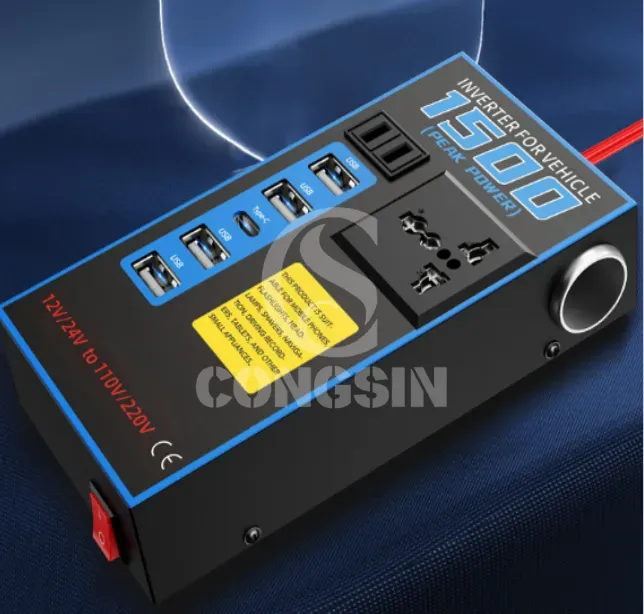
Congsin 1500W Inverter for Vehicle DC 12V/24V to AC 110V/220V with Universal socket Modified Sine Wave
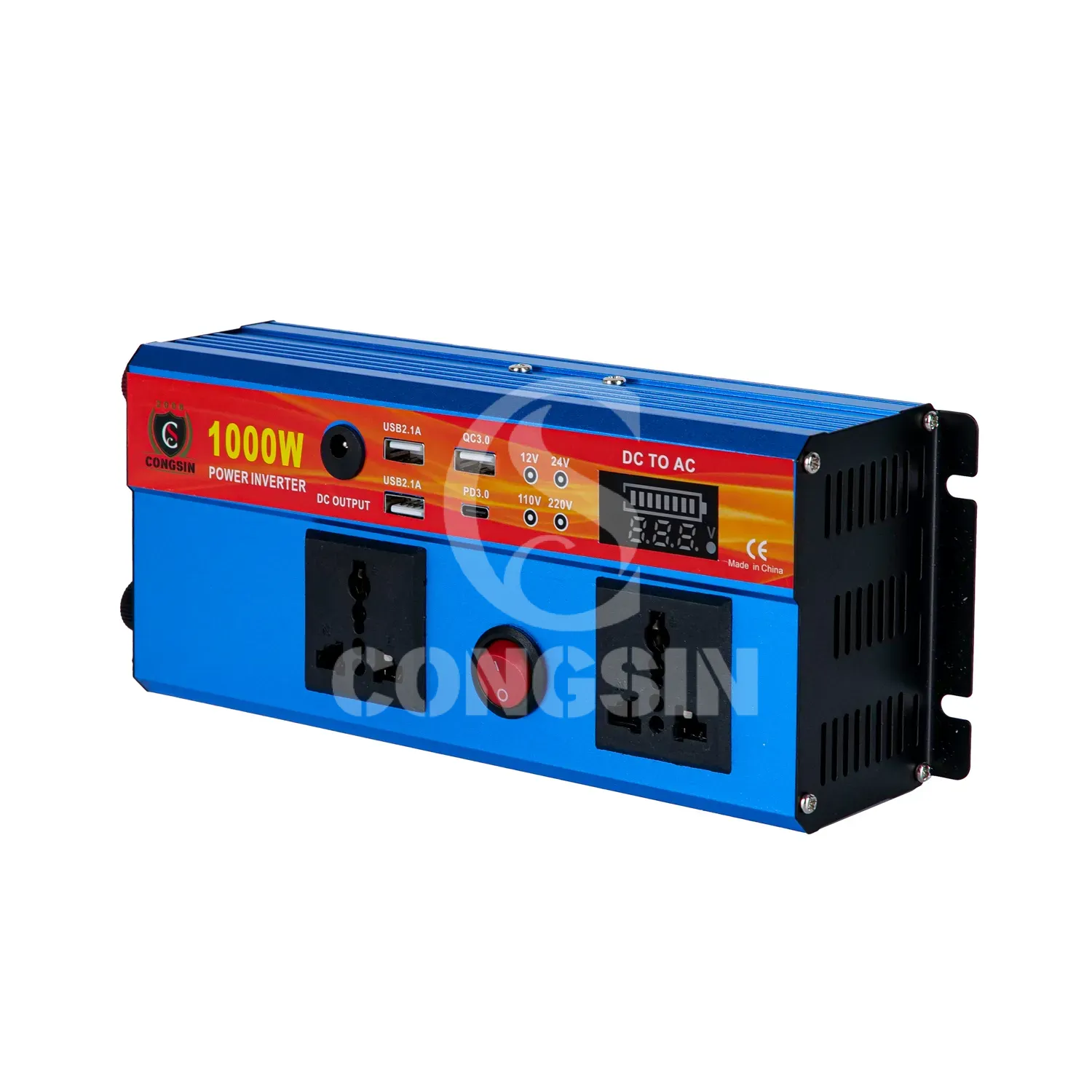
Congsin 1000W modified sine wave inverter with LED display and Type C port car RV power inverter
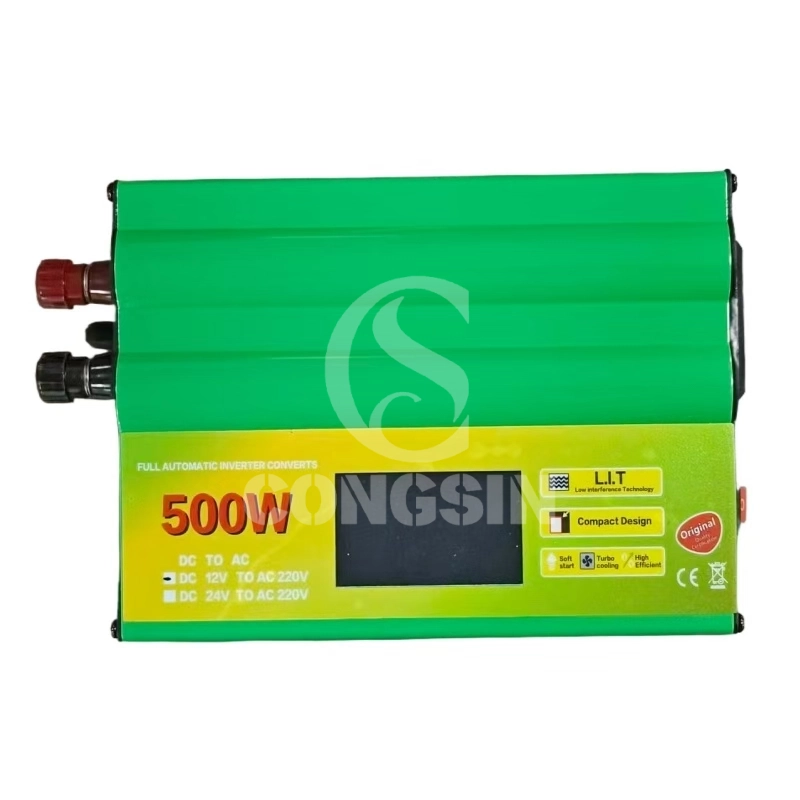
Congsin Modified Sine Wave Inverter 500W 1000W 1500W 12V LED Display Portable for RV Car Solar
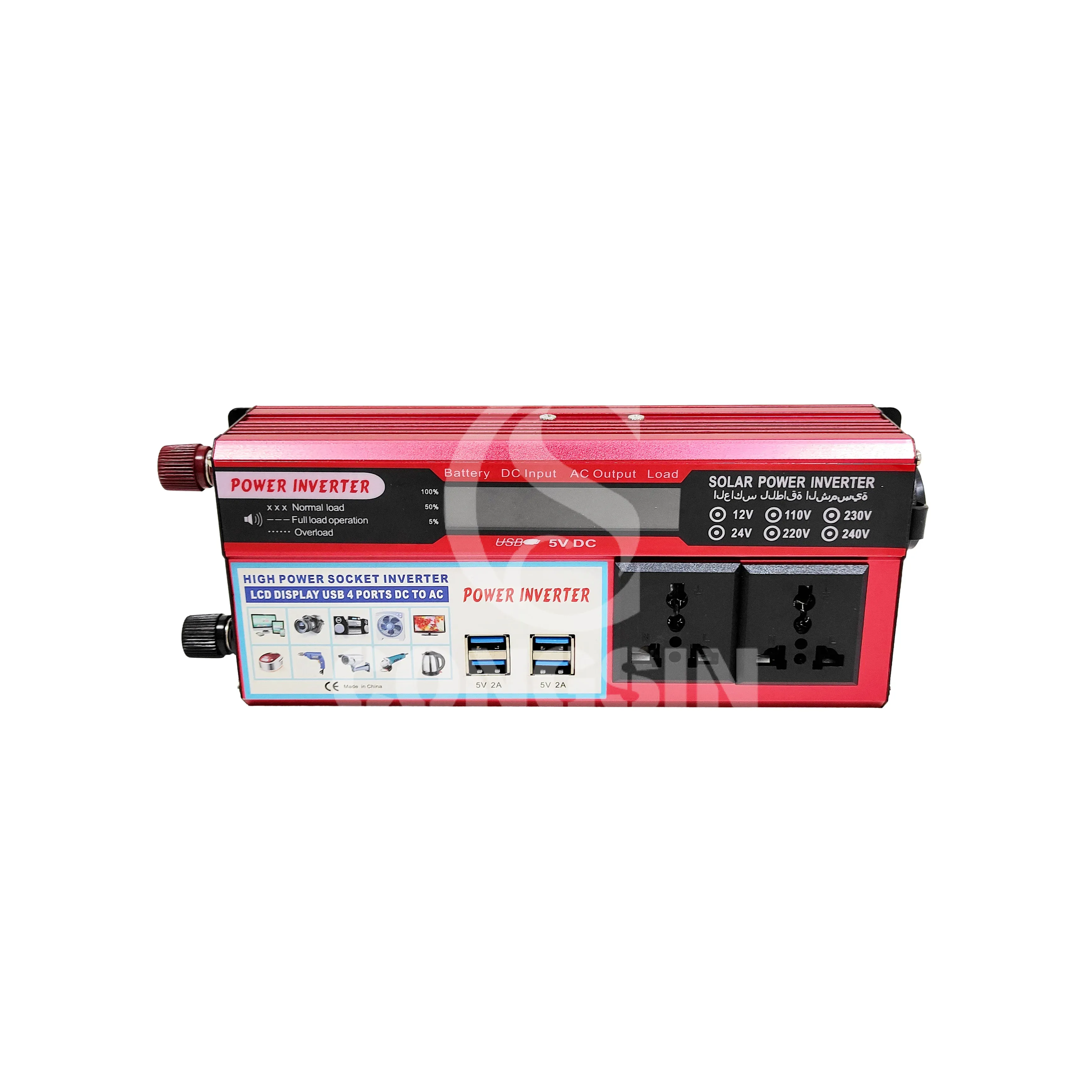
Congsin 1500W modified sine wave inverter with LCD display and USB ports for RV car boat home use

CONGSIN is a trusted OEM factory for power inverters, solar charge controllers, and DC converters. Reliable solutions for global B2B buyers.
 High Quality
 7/24 Service
 Guaranteed Warranty
© 2025 Congsin. All Rights Reserved.